1. Introduction
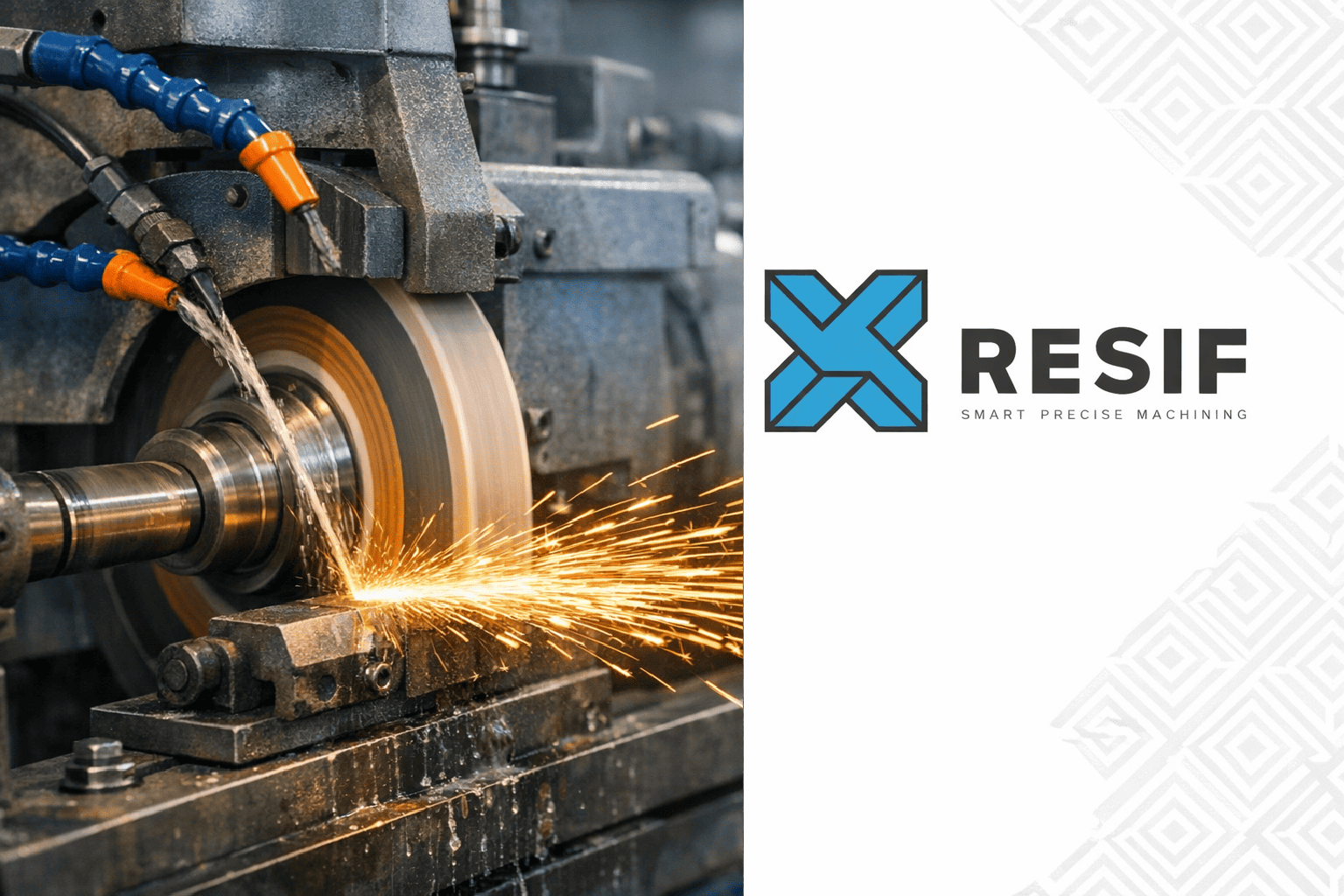
Grinding is an abrasive machining process that removes a thin layer of metal from the surface of a part to achieve high dimensional accuracy and the required surface finish. In modern industry, metal grinding is one of the key finishing operations after turning, milling, or heat treatment.
Technologies such as surface grinding and centerless grinding play a particularly important role in modern metalworking, ensuring high geometric accuracy and stability of part parameters during mass production.
The main objective of grinding is to ensure precise part geometry, minimal surface roughness, and dimensional stability. Depending on the technology and equipment, machining accuracy can reach 0.001 mm, and surface roughness can range from Ra 0.2 to 0.8 µm.
2. What is Metal Grinding
Metal grinding is the process of removing a microscopic layer of material using an abrasive tool, most often a grinding wheel. Abrasive grains act as multiple micro-cutting elements that successively remove small metal particles.
Main parameters of the grinding process
| Parameter | Value | Effect |
| Wheel speed | 20–80 m/s | Surface finish |
| Feed rate | 0.5–5 mm/min | Productivity |
| Cutting depth | 0.005–0.05 mm | Machining accuracy |
For example, increasing the grinding wheel speed improves surface quality, but requires effective cooling to prevent metal overheating and the formation of thermal defects.
3. Types of Grinding
Various grinding technologies are used in industrial metalworking, but the most common are surface grinding and centerless grinding.
3.1 Surface Grinding
Surface grinding is used to machine flat surfaces of metal parts. During the grinding process, the part is clamped on the grinding machine table, usually with a magnetic chuck. The rotating abrasive wheel removes a thin layer of metal, ensuring high geometric accuracy.
The process can be performed in two main ways:
longitudinal grinding, in which the table with the part moves along the working surface of the wheel;
plunge grinding, in which the wheel gradually penetrates the surface of the part.
Surface grinding is widely used in the manufacture of:
- base plates;
- mechanical housings;
- machine guides;
- Mold elements;
- Industrial equipment parts.
The main technical advantages of this technology are:
- Flatness accuracy up to 0.002 mm per 100 mm of length
- Dimensional repeatability of ±0.005 mm
- Roughness Ra 0.2–0.4 µm
- Ability to machine hardened steels up to HRC 62
Modern surface grinding machines are equipped with automatic feed systems and digital control systems, which significantly improve the accuracy and repeatability of machining results.
3.2 Centerless Grinding
Centerless grinding is a highly productive method for machining cylindrical parts without clamping them to the machine’s centers. The workpiece is positioned between two wheels—a grinding wheel and a regulating wheel—and rests on a special guide rail.
The grinding wheel performs the primary function of removing metal, while the regulating wheel sets the rotational speed of the part and its axial movement.
There are two main methods of centerless grinding:
- through grinding, in which the part is continuously moved through the work area;
- plunge grinding, used for machining stepped or short parts.
This method is widely used in the manufacture of the following components:
- shafts;
- rollers;
- axles;
- bushings;
- studs;
- bearing components.
The main advantages of centerless technology are:
- high productivity;
- no need for part centering;
- dimensional stability in serial production;
- ability to machine long and thin workpieces;
- high cylindricity accuracy down to 0.002 mm.
In serial production, centerless grinding allows for the processing of up to 500–800 parts per hour, making it one of the most efficient abrasive machining technologies.
4. Applications of Grinding
Metal grinding is used in virtually all industries that require high precision and quality of workpiece processing.
Main applications:
- Mechanical engineering;
- Automotive industry;
- Aircraft manufacturing;
- Cutting tool manufacturing.
Grinding applications by industry
| Industry | Processing Type | Purpose |
| Mechanical Engineering | Surface Grinding | Geometric Accuracy |
| Automotive | Centerless Grinding | Series Shaft Machining |
| Tool Industry | Cylindrical Grinding | Cutting Edge Accuracy |
Grinding ensures high-precision mating of parts and stable operation in mechanisms.
5. Advantages of Professional Grinding
Modern grinding services offer a number of technological advantages:
- High dimensional accuracy – up to 0.001 mm;
- Minimal surface roughness (Ra 0.2–0.8 µm);
- Ability to machine hardened steels;
- Increased component life;
- Stability of parameters during serial production.
High-quality metal grinding significantly improves the performance characteristics of parts, reduces friction, and increases the reliability of mechanical components.
6. Metal Grinding Services from RESIF Technologies Bel
RESIF Technologies Bel provides professional grinding services to companies in various industries.
The company’s main areas of work:
- Flat grinding of parts;
- Centerless grinding of cylindrical products;
- Machining of parts according to technical drawings;
- Serial and custom metalworking.
The company has a finishing section, unique in Belarus. This equipment effectively removes machining traces and creates a neat, marketable appearance for parts.
The process focuses on controlling geometry and surface roughness parameters, which ensures shape accuracy and the required finish quality.
Experienced operators and technologists select the optimal processing modes for each part.
The section supports the processing of various grades of steel and metal alloys, providing a wide range of production options.
7. Conclusion
Metal grinding is an important part of modern metalworking and ensures high precision and surface quality of parts. Technologies such as surface grinding and centerless grinding are particularly widely used, allowing for the efficient processing of both flat and cylindrical components.
Using professional metal grinding services ensures dimensional stability, increased part life, and reliable machine operation, making grinding a key process in industrial production.