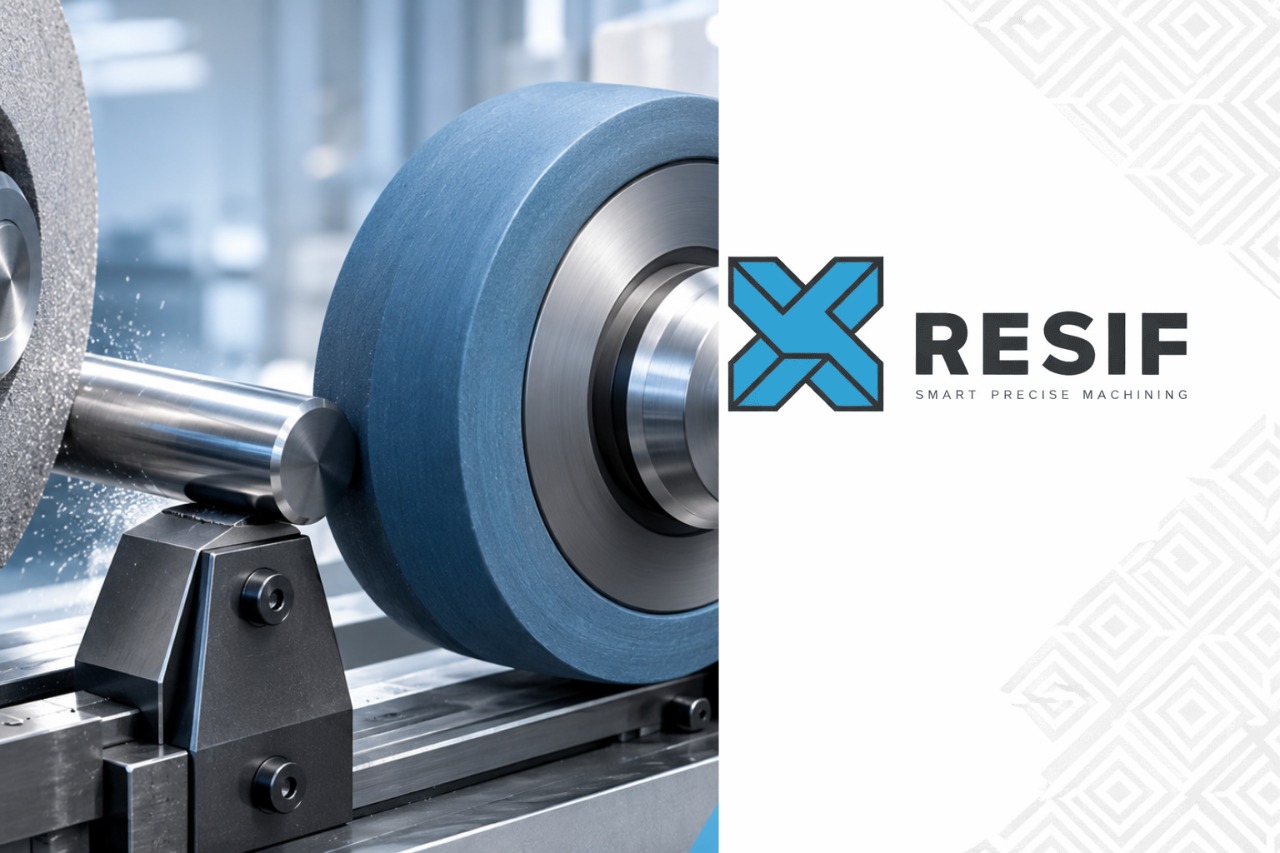
Centerless grinding is an abrasive machining method in which the workpiece is not mounted between centers or secured in a chuck. Instead, the workpiece is positioned between a grinding wheel and a regulating wheel and supported by a workrest blade.
The technology is primarily used for machining the external cylindrical surfaces of rotational components. Depending on the design of the part and the specific requirements, it can be used to grind smooth and stepped surfaces, as well as individual conical and contoured sections.
The main difference between centerless grinding and grinding between centers lies in the method of workpiece positioning. In a conventional setup, the position of the workpiece is determined by center holes or another fixture. In centerless grinding, the workpiece simultaneously contacts several machine elements that ensure its stable position and rotation.
This principle reduces auxiliary time and makes it possible to organize continuous processing of large quantities of identical parts.
How Does a Centerless Grinding Machine Work?

An image corresponding to this section should be selected.
OR
The working area of a centerless grinding machine includes several main components:
- Grinding wheel — directly removes material from the surface of the workpiece;
- Regulating wheel (control wheel) — controls the rotation and feed rate of the workpiece;
- Workrest blade — supports the workpiece from below and determines its position relative to the working wheels;
- Workpiece — the part whose surface is being machined;
- Guides and feeding devices — provide the loading and unloading of workpieces during batch or automated processing.
The grinding wheel rotates at a high peripheral speed and performs the main material removal operation. The regulating wheel rotates considerably more slowly. Through contact with its surface, the workpiece is driven into rotation.
At the same time, the workpiece rests on the blade and is held between the two wheels. This ensures a stable position of the part during machining.
The regulating wheel plays a particularly important role in process accuracy. Its working surface must provide reliable contact with the workpiece and transmit the required rotational motion without slipping.
The position of the workrest blade, the height of the workpiece relative to the wheel axis, the parameters of the regulating wheel, and the machining conditions directly affect the dimensional accuracy, roundness, and surface quality of the finished part.
One of the key advantages of this technology is that each workpiece does not need to be individually installed in a clamping fixture. Once the equipment has been set up, workpieces can be continuously fed into the working area, which is particularly effective in high-volume production.
Main Types of Centerless Grinding
Based on the feeding method and the nature of the machining operation, two main types of centerless grinding are distinguished: through-feed grinding and in-feed grinding.
Through-Feed Grinding
In through-feed grinding, the workpiece continuously passes through the working zone between the grinding wheel and the regulating wheel.
For this purpose, the regulating wheel is positioned at a specific angle relative to the axis of the workpiece. This creates an axial component of force that moves the part along the machining zone.
This method is well suited for parts with a simple cylindrical shape where the machined surface has a constant or nearly constant diameter along its length.
Through-feed grinding makes it possible to organize a continuous flow of parts and provides high productivity. It is therefore commonly used for manufacturing large quantities of identical cylindrical components.
In-Feed Grinding
In-feed grinding is used for parts that cannot be processed by simply passing them through the working zone. This method is particularly suitable for stepped, contoured, and complex-profile components.
In this case, the workpiece is positioned in the working zone, after which the grinding wheel moves relative to the part by a specified amount. Machining is performed on a specific section without passing the workpiece through the machine.
To obtain the required geometry, the profile of the grinding wheel or the path of its movement must correspond to the shape of the surface being machined.
The in-feed method makes it possible to process individual sections of a part with different diameters and configurations, making it more versatile than through-feed grinding for complex components.
Grinding and Regulating Wheels: Selection and Requirements
The selection of the abrasive tool is one of the key factors determining the productivity and quality of centerless grinding.
When selecting a grinding wheel, the following factors are taken into account:
- workpiece material;
- hardness and mechanical properties of the material;
- required machining accuracy;
- required surface roughness;
- amount of material to be removed;
- rotational speed;
- cooling conditions;
- specific characteristics of the equipment.
Not only the dimensions of the wheel are important, but also the type of abrasive material, grit size, wheel hardness, and structure.
Aluminum oxide wheels may be used for machining common structural steels. When working with harder and more difficult-to-machine materials, specialized abrasives may be used, including cubic boron nitride (CBN) and diamond abrasives.
CBN is particularly effective for machining hardened steels and other hard alloys. Diamond abrasives are mainly used for materials for which diamond is technologically suitable, such as certain hard non-metallic materials and hard alloys.
To maintain stable geometry, the working surface of the grinding wheel is periodically dressed. This operation restores the required profile, removes dull or loaded abrasive areas, and helps maintain consistent machining characteristics.
The regulating wheel also requires proper selection and adjustment. Its primary function is not material removal but reliable rotation and control of the workpiece movement. Therefore, the characteristics of its working surface must provide the required level of contact and traction with the part.
Advantages of Centerless Grinding
Centerless grinding is particularly effective in batch and mass production environments. Its main advantages include:
- high productivity — machining can be performed in an almost continuous flow;
- reduced auxiliary time — individual positioning of each part between centers is not required;
- dimensional stability — after proper machine setup, a large number of parts with closely matching parameters can be produced;
- automation capabilities — the process can be easily integrated into automated feeding and machining lines;
- machining of small cylindrical parts — the technology is well suited for components that are difficult or inconvenient to secure using conventional methods;
- high machining speed — the selected operating conditions allow efficient removal of material from the external surface;
- ability to process different materials — with the appropriate abrasive tool, a wide range of metal workpieces can be machined.
At the same time, the technology requires precise adjustment of the relative positions of the wheels, workrest blade, and feeding system. Incorrect setup or inappropriate machining parameters may result in form deviations, deteriorated surface roughness, and dimensional instability.
Applications of Centerless Grinding
Due to its high productivity and ability to achieve stable geometric parameters, centerless grinding is used across a wide range of manufacturing industries.
Key applications include:
- automotive manufacturing — machining shafts, axles, bushings, rollers, and other components;
- mechanical engineering — manufacturing cylindrical components and rotational parts;
- aerospace industry — production of high-precision mechanical components;
- medical industry — machining small metal components;
- energy industry — manufacturing components for equipment and rotating assemblies;
- defense industry — production of critical metal components;
- agricultural machinery manufacturing — machining shafts, axles, and other high-volume components;
- household appliances — manufacturing components for mechanisms and drive systems;
- motorsport — production of components requiring high machining accuracy;
- research and development manufacturing — machining specialized parts and components.
Conclusion
Centerless grinding is a highly productive abrasive machining method for processing the external surfaces of rotational components. Unlike grinding between centers, the workpiece is not mounted on a spindle or positioned between centers. Instead, it is held between the grinding and regulating wheels and supported by a workrest blade.
The technology is particularly effective for batch and mass production because it allows large quantities of identical parts to be processed with minimal auxiliary time and a high degree of automation. Through-feed grinding is primarily used for simple cylindrical workpieces, while in-feed grinding is suitable for parts with stepped, contoured, and other complex external surfaces.
Machining quality depends on the correct selection of the abrasive tool, grinding parameters, and the accuracy of machine setup. When the required technological parameters are maintained, centerless grinding makes it possible to achieve stable dimensions, accurate geometry, and the required surface roughness.
If you require machining of a batch of parts to specified accuracy and quality requirements, our company provides centerless grinding services that can deliver the required characteristics of the finished components. The technology and machining parameters are selected according to the material, dimensions, configuration of the workpieces, and technical documentation requirements.
To calculate the cost and agree on the machining technology, send our specialists the drawings or the main specifications of the parts.